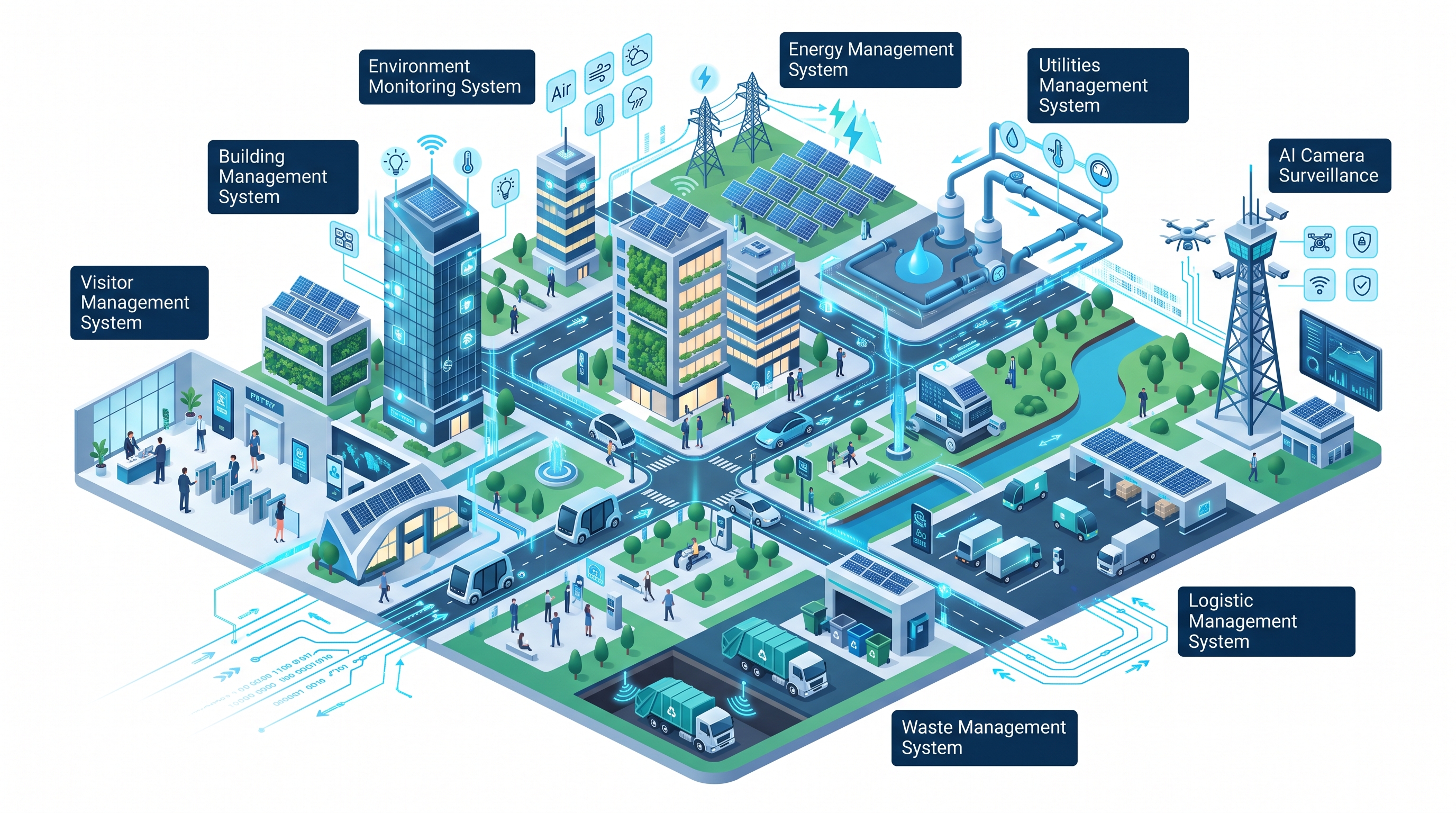
Smart City Architecture (4-Layer Architecture)
The Smart City architecture is divided into 4 core layers to support data flow from the physical level to city management decision-making:
Sensing & Physical Layer: Field devices and sensors layer (CCTV, PM2.5 Sensors, Smart Meters, Ultrasonic Bin Sensors, Access Control)
Network & Connectivity Layer: Communication network layer for data transmission (5G, Fiber Optic, LoRaWAN, NB-IoT)
Data Platform & Middleware Layer: Centralized data management platform layer (Data Lake, AI Analytics Engine, Open API Gateway, Cyber Security Framework)
Application & Operational Layer: Operational layer comprising all 8 systems directly connected to the IOC for real-time visualization and automated command
In-depth Look at the 8 Core Smart City Systems
| System | Core Role & Main Functions | Connected Devices & Sensors | Results & Value Proposition |
|---|---|---|---|
| 1. Visitor Management (VMS) | Pre-register visitors, issue QR Passes, automated access screening | LPR Cameras, E-Gate, Turnstile, Kiosk | Reduces queuing time by 70%, enhances area security |
| 2. Building Management (BMS) | Automated control of HVAC, lighting, elevators, and fire protection systems | DDC Controllers, Thermostats, Flow Meters, Fire Panels | Reduces building energy consumption by 15–25% |
| 3. Environment Monitoring (EMS) | Real-time monitoring of PM2.5, PM10, noise, temperature, and water quality | Air Quality Stations, Noise Sensors, Water Quality Probes | Early warning for health risks, pollution, and natural disasters |
| 4. Energy Management (EnMS) | Manages electricity usage, Solar PV systems, and BESS battery storage | Smart Power Meters, Inverters, BESS Controllers | Reduces Peak Demand Charges and increases clean energy utilization |
| 5. Utilities Management (UMS) | Automated monitoring of water/electricity usage and pipe leak detection | Smart Water Meters, Flow/Pressure Sensors, Acoustic Leaks | Promptly reduces Non-Revenue Water (NRW) losses |
| 6. AI Camera Surveillance & Alert | Analyzes abnormal events, watchlisted individuals, overcrowding, and accidents | AI IP Cameras, Edge AI Box, Video Management System | Responds to emergencies and crime 50% faster |
| 7. Logistic Management (LMS) | Manages delivery vehicles, loading bay reservations, and EV fleets | GPS Trackers, RFID Bay Sensors, EV Chargers | Reduces transport congestion and carbon emissions |
| 8. Waste Management (WMS) | Monitors bin fill levels and automatically calculates garbage truck collection routes | Ultrasonic Fill-level Sensors, Vehicle Route GPS | Reduces collection trips, saving 20–30% in fuel consumption |
Data Integration into the Intelligent Operation Center (IOC)
The core of building a Smart City is data cross-integration from all 8 systems to enable automated decision-making, such as:
PM2.5 Crisis Response (EMS + BMS + VMS): When EMS detects PM2.5 levels exceeding safety standards, it automatically commands the BMS to increase positive air pressure inside the building, while sending alert notifications to visitors via the VMS.
Emergency Management (AI Surveillance + BMS + LMS): When AI cameras detect a fire, the system alerts the IOC while triggering the BMS to automatically unlock emergency doors and instructing the LMS to clear traffic lanes for firefighters to reach the scene as quickly as possible.
Energy & Environmental Management (EnMS + BMS + WMS): Adjusts building HVAC cooling based on occupancy density and schedules garbage collection during off-peak traffic times to minimize fuel and transport energy costs.